
Innovation Living Review for Refined Homes
An Innovation Living review for discerning homes: Danish sofa bed comfort, mechanisms, materials, and models for considered guest spaces in Singapore.

A dining table is often the most hardworking piece in a considered home. It hosts quick weekday meals, long conversations, children’s projects, and the occasional larger gathering. Choosing a solid wood dining table Singapore homeowners can live with for decades is therefore less about finding a dramatic centerpiece than understanding material, proportion, and the quiet details that make daily use feel effortless.
Solid wood has a presence that veneer and composite materials cannot replicate. Its grain has depth, its edges soften gracefully with time, and its surface can be renewed rather than simply replaced. For interiors shaped by Scandinavian principles, this honesty of material is central: the table should be useful, beautifully resolved, and increasingly personal as it ages.
The first decision is the species of wood. Oak is a natural starting point for many contemporary interiors because it is visually calm, structurally dependable, and available in a broad range of finishes. Pale oak brings lightness to compact apartments, while smoked, soap-treated, or darker oiled oak can give a dining space greater definition without making it feel heavy.
Walnut offers a richer expression. Its deeper brown tones and flowing grain work particularly well where the dining area needs warmth or contrast against pale walls, stone, or soft upholstery. It is an inherently more expressive timber, so it benefits from surrounding materials that allow its character to remain visible.
Ash has a lighter, more linear grain and an unmistakably Nordic clarity. It suits rooms where a table should feel almost architectural in its restraint. The right timber is not simply the one that matches the floor. A close match can be elegant, but contrast often creates a more layered and intentional room.
Look closely at how the wood is selected and joined. A well-made solid wood table respects natural variation rather than disguising it. Small differences in grain and tone are part of the material’s integrity, especially on broad tabletops where the timber is allowed to speak for itself.
A table can be beautifully designed and still feel wrong if its scale interrupts the way a room functions. Start by measuring the full dining zone, not only the space occupied by the table. As a useful rule, allow roughly 36 inches between the table edge and a wall, cabinet, or other fixed obstruction. This gives diners room to pull out chairs and move around the table without constant adjustment.
For seating, allow about 24 inches of table width per person. A 71-inch rectangular table will usually seat six comfortably, while an 87-inch table is more accommodating for eight. These are guides, not fixed rules. Chair width, armrests, and the table’s leg placement all affect how generously people can sit.
In a condominium dining area, a round table can be the more intelligent choice. It softens circulation, avoids sharp corners in tighter layouts, and makes conversation feel more inclusive. A rectangular table remains ideal for longer rooms and for households that entertain frequently. Oval forms offer a useful middle ground, carrying the sociability of a round table with the seating capacity of a rectangle.
Do not overlook the base. Four corner legs are familiar and often beautifully proportioned, but they can limit where chairs are placed. A pedestal or trestle base may make flexible seating easier, particularly when extra guests join at the ends. The best solution depends on how you actually use the table, not only how it appears in a styled setting.

An extendable dining table is not a compromise when the mechanism and construction are thoughtfully resolved. It is a way to preserve openness day to day while remaining ready for family dinners and celebrations. The key is to inspect the table both closed and extended. Its proportions should feel composed in each position, and the extension should not make the base feel visually or physically inadequate.
For a smaller household, this flexibility can be especially valuable. Choose the everyday size for the room you inhabit most often, then let the extension serve the occasions that ask for more. A table should support hospitality without requiring the entire home to be arranged around it.
Scandinavian dining furniture is often admired for simplicity, but simplicity requires precision. The apparent ease of a clean-lined oak table rests on considered thicknesses, carefully shaped edges, balanced leg angles, and a relationship between top and base that feels settled from every viewpoint.
A substantial tabletop can lend permanence to a larger room, particularly when paired with upholstered dining chairs or a sculptural pendant. In a more compact space, a slimmer profile and softly rounded edge can keep the room airy. Neither approach is inherently superior. The appropriate visual weight depends on the ceiling height, flooring, nearby cabinetry, and the presence of other strong forms.
Chairs should be selected with the table rather than afterward. Contrast can be compelling: woven paper cord against oak, leather against ash, or upholstered seats beside a refined timber surface. Yet the heights must work together. The dining experience is shaped as much by knee clearance, arm height, and seat comfort as it is by the silhouette seen from the doorway.
Lighting deserves the same attention. A pendant should center on the table rather than the room if those two axes differ. Its scale should give the table a visual anchor without blocking sightlines across it. In open-plan homes, this single decision often makes the dining area feel deliberate rather than incidental.
Wood is a living material. In Singapore’s warm, humid climate, seasonal movement is part of its nature, not a flaw. Responsible construction allows timber to expand and contract subtly, while a suitable finish helps protect the surface from the demands of dining.
Oil finishes retain a tactile, natural feel and make local touch-ups more approachable. They suit those who appreciate a surface that develops a gentle patina. They also ask for more attentiveness: spills should be wiped promptly, and periodic care may be needed to preserve an even appearance.
Lacquered finishes generally offer greater resistance to everyday staining and can be practical for active family use. They may feel less immediate to the touch than an oiled surface, but a finely applied matte lacquer can preserve much of the timber’s visual warmth. Soap-treated wood has a pale, velvety character associated with Danish furniture traditions, though it requires an owner willing to follow its care routine.
No finish makes a table invulnerable. Use placemats for hot dishes, wipe moisture rather than leaving it to sit, and avoid harsh household cleaners. Direct sun can alter wood over time, so sheer window treatments or thoughtful placement are worthwhile where afternoon light falls strongly across the tabletop. These are not burdensome rituals. They are the modest care that lets a natural material remain beautiful.
A lasting table is judged in the details that are easy to miss at first. Run a hand beneath the edge. Consider whether the underside is resolved with the same care as the visible top. Look at the junction between leg and apron, or at the engineering of a pedestal. Open an extension mechanism more than once. Sit at it, not just beside it.
Authentic European design often carries an understanding of use refined over generations of making. That heritage is visible not as ornament, but as restraint: joinery that supports the structure, edges that are comfortable to touch, and forms that remain convincing after changing tastes have passed.
For homeowners furnishing a residence intended to evolve over many years, a showroom visit is valuable. Seeing timber under natural and artificial light, testing chair-table relationships, and comparing finishes side by side brings clarity that screen images cannot provide. Danish Design Co can offer this kind of considered selection, including in-stock pieces for homes with more immediate timelines.
Choose the table that feels proportionate to your life rather than merely impressive in a photograph. When its material is honest, its scale is calm, and its craftsmanship rewards close attention, it will become more than a place to eat – it will be the surface around which a home gathers.

An Innovation Living review for discerning homes: Danish sofa bed comfort, mechanisms, materials, and models for considered guest spaces in Singapore.
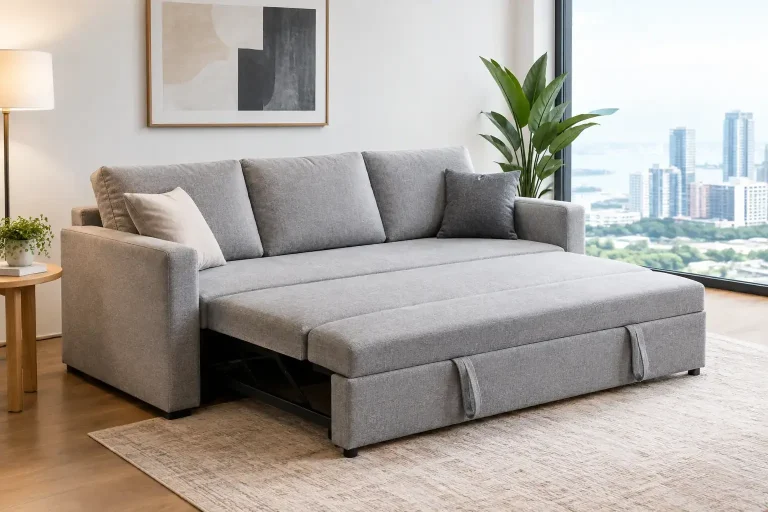
Designer sofa beds Singapore homeowners can live with: considered guidance on comfort, proportion, craftsmanship, and choosing a lasting European design.