

Designer Rugs for Modern Homes That Last
Designer rugs for modern homes bring warmth, acoustic ease, and visual order. Learn how to choose material, scale, and color with lasting clarity at home.
A sofa bed for daily sleeping is not a compromise piece tucked away for occasional guests. It is a bed, a sofa, and often the visual anchor of a compact living space. That dual role calls for more than an attractive silhouette: it requires sound construction, a sleep surface with proper support, and proportions that remain gracious when the bed is closed.
For a primary residence, the right choice is rarely the most elaborate mechanism or the softest first impression. It is the model that performs with quiet consistency, night after night, while retaining the clarity of form and comfort expected from a well-made sofa.
The central question is simple: would you be content sleeping on it every night if it were in a dedicated bedroom? If the answer is uncertain, it is better understood as a guest bed rather than a true everyday solution.
Daily use places repeated demands on the opening mechanism, frame joints, seat cushions, mattress, and upholstery. A design intended for this role should open without excessive lifting, forcing, or rearranging. The transition from sofa to bed ought to feel deliberate and intuitive, particularly in a home where it happens every evening.
Equally important, the sleeping surface should be continuous and properly supported. Some sofa beds use a fold-out mattress on a slatted or sprung base; others convert through a pull-out platform, while certain designs use rearranged seat and back cushions. Each approach can work well, but they offer different experiences. A dedicated mattress system often feels closest to a conventional bed. A platform design can provide a firmer, more even surface. Cushion-based conversions are visually refined in some contemporary interiors, though they demand careful assessment of seams, cushion movement, and long-term resilience.
The best option depends on how you sleep, not simply on how it looks in a showroom.
When choosing a sofa bed for daily sleeping, test it in its open position. Sit on it, certainly, but spend more time considering the bed. Lie flat on your back and side. Notice whether your shoulders and hips are supported, whether you can feel a join beneath the sheet, and whether the usable length accommodates your height without your feet pressing into the frame.
Mattress thickness alone is not a reliable measure of comfort. A thinner, well-engineered mattress with appropriate support beneath it may feel far better than a thicker mattress on an inadequate base. Look for even weight distribution, stable edges, and a surface that does not sag toward the center.
Your preferred sleep feel matters. Those accustomed to a firmer European mattress may appreciate a supportive slatted base or high-resilience foam construction. Sleepers who prefer more pressure relief may favor a mattress with a more yielding comfort layer. Neither is inherently superior. What matters is that the bed maintains its character over time rather than becoming uneven after regular compression.
For two sleepers, width deserves particular attention. A bed that appears generous in a living room can feel narrow once pillows, bedding, and two bodies are accounted for. Measure the sleeping area rather than relying on broad labels such as double or queen, which can vary by manufacturer and market.
A mattress can only perform as well as its foundation. Slats should be evenly spaced and secure; a metal deck should feel stable rather than flexible in isolated sections. If the design incorporates webbing or springs, ask how the structure is intended to distribute weight across the bed.
Listen for movement, too. A small degree of mechanical sound is normal, but persistent creaking or shifting can become tiresome when the piece is used every day. In a premium sofa bed, the mechanism should feel composed, with components that align cleanly and lock into place without uncertainty.
A refined upholstery fabric may be the first thing you see, but the frame is what determines whether the sofa bed remains dependable. Seek a substantial internal structure, carefully joined components, and a mechanism engineered for repeated cycles. The most successful designs conceal this complexity elegantly, allowing the sofa to retain a calm, resolved appearance.
Opening the bed in person is worth the time. Consider the full sequence: Do cushions need to be removed? Where will they go? Can one person manage the transformation comfortably? Does the extended bed require the sofa to move away from the wall? These details shape everyday living more than a brochure image can convey.
Some mechanisms preserve the seat cushions in place, while others require them to be set aside before opening. The former may save time; the latter can sometimes allow a more conventional mattress construction. There is no universal rule. In a smaller apartment, however, a design that minimizes loose components can make the evening routine notably easier.
A sofa bed has two footprints, and both need to be planned with precision. Measure the room with the bed fully extended, leaving enough clearance for walking around it and for opening nearby doors, drawers, or wardrobes. In a compact urban interior, this can determine whether the piece feels purposeful or permanently obstructive.
Also examine the sofa’s closed proportions. Deep seats and broad arms may be inviting, but they consume valuable floor area. A more finely drawn frame can offer the same seating capacity with greater visual lightness. Legs that lift the body from the floor often help a room feel more open, while an upholstered base can create a more grounded, architectural presence.
The height of the sleeping surface is another practical consideration. A low platform may suit a relaxed, contemporary room, yet a slightly higher bed can be easier to rise from each morning. Think about the user, not only the room image.
Daily sleeping means daily bedding. Before choosing, decide where sheets, pillows, and a duvet will live during the day. Integrated storage can be useful, but it should not be treated as a substitute for a sound bed mechanism. If the storage is accessed only when the sofa is fully opened, it may be less convenient than it first appears.
A dedicated basket, cabinet, or nearby closet can make the conversion feel less like a chore. This is particularly relevant in a studio or multifunctional room, where a composed morning reset helps the space return to its daytime purpose.
Upholstery should be selected with the same care as a permanent sofa. A sofa bed used nightly experiences friction from sitting, sleeping, changing linens, and repeated folding. Tightly woven textiles, quality wool blends, and durable natural-fiber compositions can offer depth and tactility while standing up to regular handling. The right fabric depends on the household, including whether there are children, pets, or frequent visitors.
Removable covers can be practical, though they are not automatically the most elegant or durable answer. Consider the tailoring, the way the cover sits over moving parts, and whether the fabric will retain its shape after cleaning. Leather brings a distinct material richness but may feel cooler or less forgiving as a direct sleep surface unless the mattress is fully separate from the upholstery.
In Singapore’s humid climate, breathable bedding, attentive ventilation, and a bedroom-like standard of care are especially worthwhile. A sofa bed should not be treated as temporary simply because it transforms.
Timeless design is not achieved by stripping away every practical feature. It comes from resolving function with discipline. A well-designed sofa bed should look complete when closed, without appearing like a bed mechanism disguised beneath cushions. Its arms, legs, upholstery, and proportions should belong naturally to the wider interior.
This is where material integrity and visual restraint become especially valuable. Select a form that works with the architecture of the room, whether that means a tailored, linear silhouette for a contemporary condominium or a softer, more generous profile for a family room. Neutral textiles can provide longevity, while a considered texture or muted color may give the room distinction without making the sofa bed feel overly dominant.
At Danish Design Co, a showroom visit can be useful precisely because comfort and mechanism quality are difficult to judge from photographs alone. Opening the bed, assessing the upholstery, and seeing its scale in person provide a more reliable basis for a long-term decision.
The right sofa bed should make no theatrical claim on the room. By day, it offers understated elegance and a place to settle in. At night, it should disappear from your awareness for the best possible reason: it lets you sleep well.
For homes where the sofa bed is a real bed, Danish Design Co carries Innovation Living – European-made convertible furniture backed by a 5-year warranty. Our edit includes the Malloy, the CozyPad Sofa Bed with Arms, the Mikunjo and the Killian, each with a mechanism and sleeping surface designed for regular use rather than the occasional guest.
See the sofa bed collection and download the catalogue, or visit our showroom at 100E Pasir Panjang Road, #06-03, to test each model in its sleeping position.
Prefer to start on WhatsApp? Request the sofa bed catalogue on WhatsApp and our team will send it over.
Designer rugs for modern homes bring warmth, acoustic ease, and visual order. Learn how to choose material, scale, and color with lasting clarity at home.
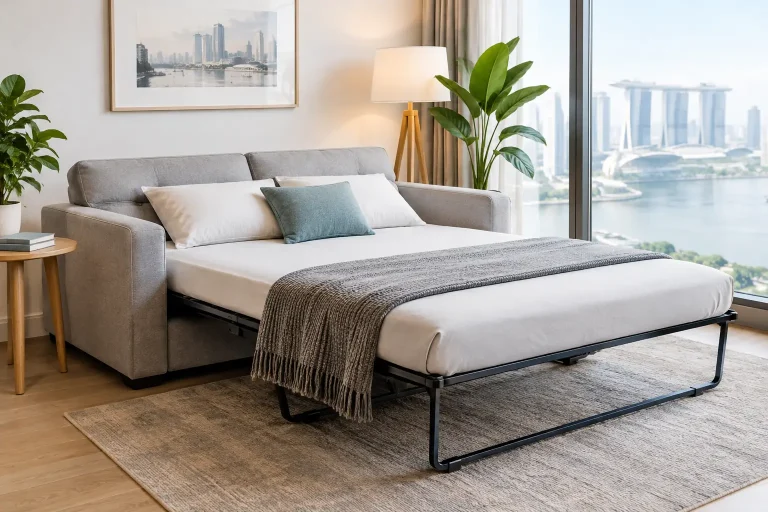
Find comfortable sofa beds Singapore homeowners can live with, from mattress support and proportions to fabrics, mechanisms, and showroom testing well.
Explore 20+ sofas, 30+ tables, and 50+ chairs in our 12,000 sq ft showroom, along with a wide selection of designer furniture. Experience quality firsthand and discover the stories behind each piece—it’s a visit truly worth your time.