
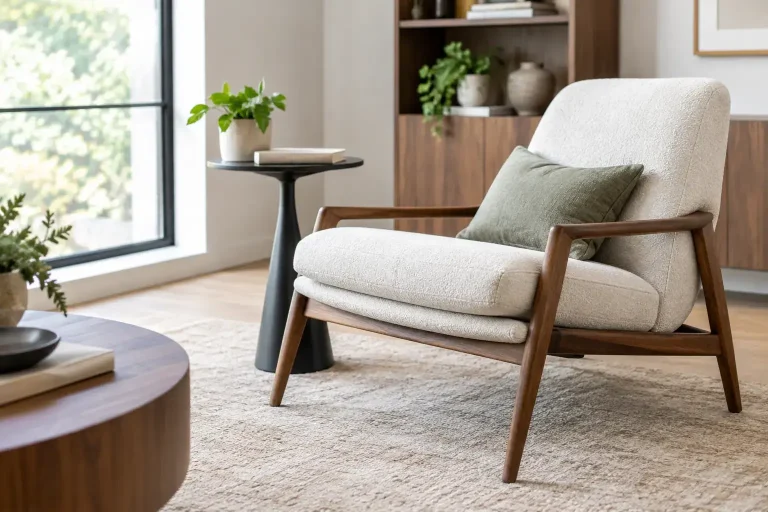
How to Choose the Best Lounge Chairs for Home
Find the best lounge chairs for poised, lasting interiors, with guidance on comfort, proportion, materials, and authentic Scandinavian design for homes.
A well-made chair can appear convincing from across a room. Authentic designer furniture reveals itself more quietly: in the discipline of its construction, the accuracy of its materials, and the continuity between the object, its maker, and its documented history. Knowing how to verify designer furniture authenticity protects more than the value of a purchase. It protects the design intent, craftsmanship, and lasting pleasure that made the piece worth seeking out.
For collectors, homeowners, and design professionals, verification should begin before a piece enters the home. The aim is not to become suspicious of every detail, but to develop a clear method for assessing provenance, production, condition, and source.
The most reliable starting point is the seller. Established design houses distribute their work through appointed retailers, showrooms, and professional channels that can identify the product, confirm its current specifications, and explain its place within a collection. This matters particularly with designs that have been in continuous production for decades, where dimensions, finishes, and labeling may have evolved under the original manufacturer’s stewardship.
Ask who made the piece, when it was produced, and how the seller acquired it. A credible answer should be specific rather than vague. For a newly produced item, there should be a recognizable relationship between the retailer and the manufacturer. For a vintage piece, there should be a coherent chain of ownership or acquisition, supported where possible by documentation, original sales materials, archival references, or a knowledgeable specialist’s assessment.
Price alone is not proof of anything. A favorable price may reflect condition, provenance, a discontinued finish, or a seller’s circumstances. Equally, a premium price does not establish authenticity. Treat pricing as one signal among many, never as the deciding test.
Most established European furniture manufacturers use identifying marks, though their format varies by era and category. Look beneath seats, inside drawers, under tabletops, behind cabinets, and on the underside of lighting components. You may find a stamped mark, paper label, metal plaque, production number, date code, or a combination of these details.
The presence of a mark is useful, but it must be read in context. Labels can change over time, disappear through restoration, or be removed during reupholstery. A vintage piece without a visible mark is not automatically unverified, just as a mark alone is not sufficient evidence. Compare the typography, placement, materials, and wording with reliable manufacturer records or references from a specialist familiar with the design period.
For current pieces, product information should align precisely with the maker’s established naming conventions, available materials, dimensions, and hardware. Small discrepancies can be meaningful. A dining chair attributed to a particular design house but offered in a wood species, upholstery, or configuration that the maker has never produced deserves further investigation.
The defining quality of enduring furniture is often found where the eye does not immediately rest. Turn the piece over, open it, sit in it, and examine its joints. Designers and manufacturers with serious craft traditions tend to resolve structure with the same care they apply to silhouette.
Solid wood furniture should show thoughtful grain selection and a finish appropriate to the species. Veneered pieces should have clean, consistent joins and a surface that follows the logic of the construction rather than disguising it. On chairs and tables, inspect how legs meet frames, how rails are integrated, and whether transitions feel deliberate. The best work has clarity of form because each element has a structural purpose.
Metal furniture offers a different set of clues. Look at the consistency of welds, bends, castings, and surface treatments. Leather should feel suited to the design and age of the piece, with stitching, piping, and upholstery tension executed evenly. On upholstered seating, the proportions of cushions and the relationship between the frame and fabric are often as revealing as the textiles themselves.
These observations do not require a workshop-level education. What matters is whether the object feels coherent. Authentic design is not merely a recognizable outline. It is a system of proportion, materiality, and construction working together.
Photographs can flatten crucial distinctions. A familiar lounge chair may look correct online while being subtly wrong in seat height, arm angle, depth, or overall scale. Obtain exact measurements and compare them with manufacturer literature, period catalogs, or dependable archival references.
Dimensions are particularly useful because they are difficult to explain away. A few millimeters may be attributable to hand finishing, age, or upholstery, but significant departures from known specifications require a credible reason. The same principle applies to details such as the number of slats, the profile of a leg, the spacing of fasteners, or the curvature of a molded shell.
If you are assessing an older item, allow for legitimate variations. Historic production methods, regional manufacturing arrangements, and later authorized editions can create differences. The question is whether those differences fit a documented production history.
Provenance is the documented story of an object’s origin and ownership. It can include an original invoice, a receipt from a recognized retailer, a certificate, correspondence, photographs of the piece in its earlier setting, or an estate inventory. The stronger and more continuous this record, the more confidence it provides.
However, many desirable vintage pieces have incomplete paperwork. A home may change hands, records may be lost, and families do not always preserve furniture receipts for generations. In these cases, authenticity is assessed through a body of evidence: correct construction, period-appropriate materials, consistent dimensions, recognizable marks, and a seller whose expertise is accountable.
Be measured with certificates. A certificate is valuable when it comes directly from the manufacturer, an established archive, or a recognized specialist and is tied clearly to the individual object. A generic statement without supporting details should not override what the furniture itself reveals.
For significant acquisitions, especially rare vintage designs or works with substantial restoration, an independent appraisal or specialist opinion can be worthwhile. It is a practical step, not an indulgence, when the cost of being wrong would be considerable.
A piece can be authentic and extensively restored. It can also be original but in poor condition. These are separate considerations, and both affect value, usability, and suitability for a particular interior.
Ask exactly what has been changed. Refinished wood, renewed webbing, replacement upholstery, updated electrical components, and repaired joints may be appropriate forms of conservation when disclosed and competently executed. Yet each intervention changes the relationship between the object and its original state. For a collector, that may affect desirability. For a family home, careful restoration may make an important design usable for another generation.
Transparency is the standard to seek. A considered seller will distinguish original elements from later work and explain why the restoration was undertaken. This allows you to judge the piece on its real merits rather than on an idealized description.
When purchasing newly made furniture, authorized retail is the clearest route to certainty. It connects the buyer to the manufacturer’s intended materials, production standards, and after-sales support. It also ensures that the proportions, finishes, and comfort of the piece reflect the designer’s approved specification.
This is especially relevant for Scandinavian and European furniture, where a design’s integrity often depends on subtle decisions: the grade of timber, the tension of an upholstery textile, the density of cushioning, or the finish applied to a hand-shaped edge. These are not ornamental details. They are part of the product’s architecture and explain why well-resolved furniture continues to feel right over time.
At Danish Design Co, the value of a curated showroom lies in being able to see those distinctions firsthand. Materials can be examined under real light, seating can be tested for everyday comfort, and the scale of a piece can be understood in relation to an actual room rather than a screen. For homeowners and specifiers alike, that clarity supports better decisions.
Before confirming a purchase, bring the evidence together. The source should be credible, the product details should correspond with known records, the construction should support the attribution, and any restoration or gaps in provenance should be openly addressed. If one element remains uncertain, ask for more information and give yourself time to assess it.
The most satisfying designer furniture is rarely chosen in haste. It earns its place through proportion, material integrity, and a history that can be understood with confidence. When those qualities are present, the piece becomes more than a signature form. It becomes a lasting part of the home.
Find the best lounge chairs for poised, lasting interiors, with guidance on comfort, proportion, materials, and authentic Scandinavian design for homes.
Visit a Scandinavian furniture showroom Singapore residents trust for authentic design, material integrity, and pieces selected for a life well lived.
Explore 20+ sofas, 30+ tables, and 50+ chairs in our 12,000 sq ft showroom, along with a wide selection of designer furniture. Experience quality firsthand and discover the stories behind each piece—it’s a visit truly worth your time.